
What Is a Mandap? Meaning, Styles & Setup Explained
By Sania Birla, Founder & Creative Director, Saba Decor Rentals
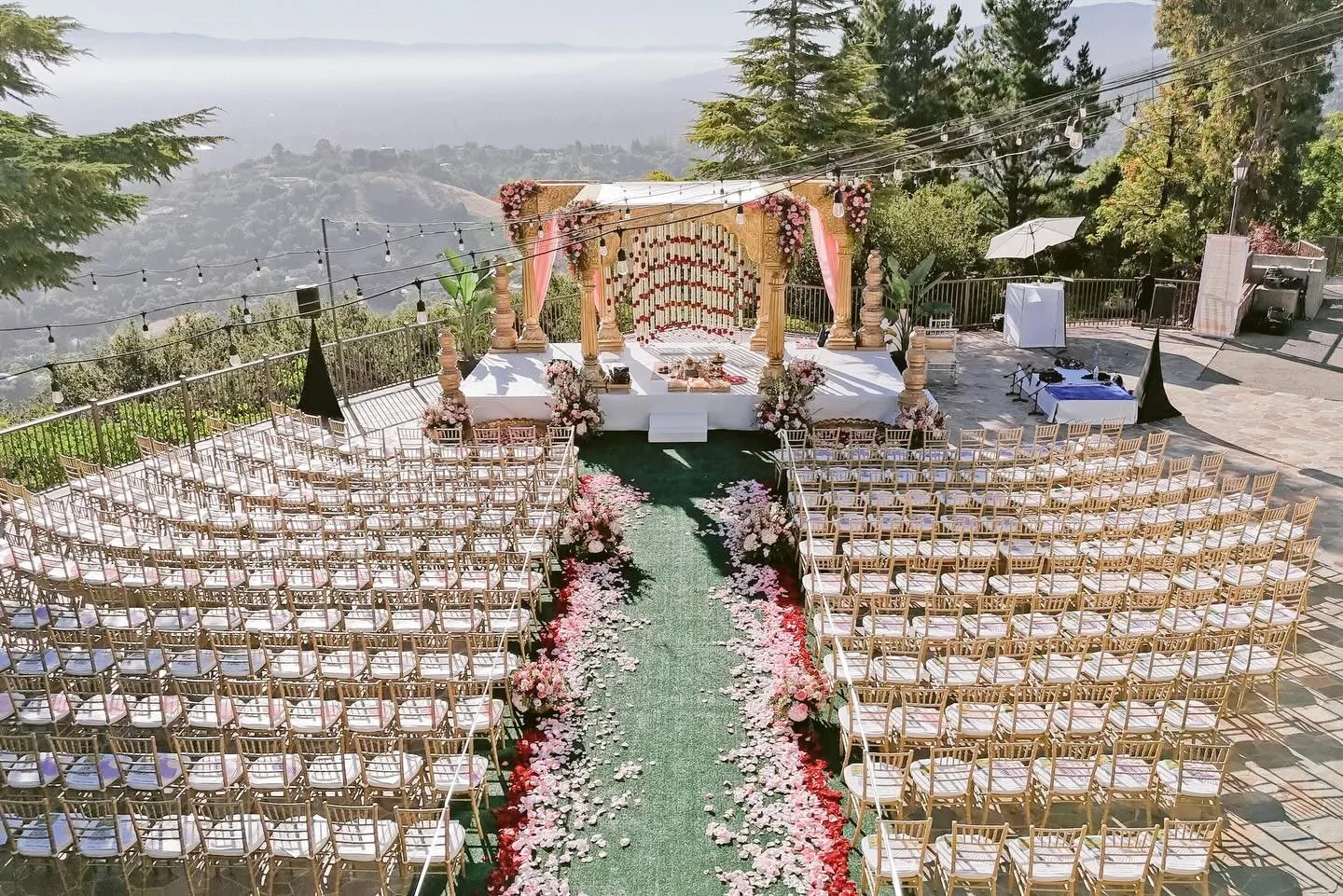
A mandap is the canopy, usually built on four pillars, where a Hindu wedding ceremony takes place. The couple, their parents, and the priest sit beneath it, and the sacred fire burns at its center while the couple takes their vows. It’s the ceremony’s stage and its sanctuary at once, which is why it’s the first piece of decor most families ask me about.
I’ve been designing for 15 years, and of all the Indian wedding decor we create, the mandap is still the piece I care about most. Below: what it means, what goes inside it, the styles we build, and what to sort out with your venue first.
Key Takeaways
It’s the canopy, usually on four pillars, where a Hindu wedding ceremony happens. The sacred fire burns in the middle.
Most families say the pillars honor the parents. Others tie them to the four aims of life. Neither is wrong.
Inside goes the havan kund for the fire, then seating for the couple and parents and a low table for the ceremony items.
Draped, wooden, open-concept, metal, dome. Choose for your venue first and the mood second.
Before you commit to anything, ask the venue about ceiling height, floor space and open flames.
What Does the Word Mandap Mean?
Mandap comes from the Sanskrit mandapa, a pillared hall or pavilion. In English you’ll hear it called a wedding canopy or wedding altar, though neither quite captures it. In South India it’s often called a mandapam, and in many Gujarati weddings you’ll see a variation called a chori, with stacked, colorful pots on each pillar.
Whatever it’s called, the idea is the same. The mandap marks off sacred space. Once the couple steps under it, the ceremony has begun.
What Do the Four Pillars Represent?
Ask five families and you may hear five answers, and that’s part of what I love about this work. The explanation I hear most is that the four pillars stand for the parents of the bride and groom, the people who raised the couple and support them as they start their own home.
Other families will tell you the pillars are dharma, artha, kama and moksha, the four aims of life in Hindu thought (duty, prosperity, love and liberation). I’ve also heard them described as the four walls of the home the couple is about to build. The Hindu American Foundation’s wedding primer covers all of these, and I don’t think any of them is wrong. So one of my first questions when we design is what the pillars mean to your family. The answer changes how we dress them.
What Happens Under the Mandap?
Rituals shift from one region and community to the next. Still, you’ll usually see some version of these moments under the mandap:
Jaimala or varmala: the couple trades flower garlands, usually right before stepping into the mandap or as they walk in.
Kanyadaan: the bride’s parents give her hand in marriage.
Agni, the sacred fire: lit in the havan kund at the center, it serves as witness to the vows.
Pheras: the couple circles the fire, four times in many traditions and seven in others.
Saptapadi: seven steps, taken together. Each one carries a promise for the marriage.
Sindoor and mangalsutra: many traditions close with the groom applying sindoor and tying the mangalsutra.
Some Gujarati families also begin with a mandap muhurat, a small puja held before the mandap goes up. If that’s part of your plans, tell us early so the structure is ready on time.
What Goes Inside a Mandap?
The frame is only part of it. The pieces inside make the ceremony work, and they’re easy to forget until the last minute:
Havan kund: the vessel that holds the sacred fire.
Seating for the couple and parents: traditionally sankheda chairs, the lacquered wooden furniture that originated in Gujarat.
Patla: a low seat or stool used during parts of the ceremony.
Bajot: a low table that holds the puja items.
Draping and a mandap cover: fabric on the frame and overhead, in your colors.
Florals: garlands, pillar wraps, or a full floral canopy, depending on the design.
Every one of our ceremony packages includes the seating set (six mandap chairs, a patla, bajot, and havan kund) along with custom-color draping, so the essentials are covered from the start. You can see what each tier includes on our South Asian wedding packages page.
Mandap Styles: Which One Fits Your Wedding?
The structure sets the mood for the whole ceremony. These are the five styles we build most often:
Pipe and drape: A light frame dressed entirely in fabric. Works best for smaller spaces and soft, flowing looks.
Wooden: A carved or solid wood frame. Works best for traditional ceremonies and warm, rich palettes.
Open-concept: A minimal frame that keeps sightlines open. Works best for outdoor and vineyard ceremonies with a view.
Metal: A metal structure in the shape you choose. Works best for modern and fusion designs.
Dome with crystal chandelier: A domed canopy with a chandelier at the center. Works best for ballrooms and grand indoor ceremonies.
I’ll be blunt about one thing: photos can mislead. A dome looks grand in a hotel ballroom, but put it under a low ceiling and it feels crowded. And the open-concept frame that’s perfect at a vineyard? In a big room it can look bare. Come see them at our Fremont showroom, and we’ll talk through how each one would sit in your space.
What to Check With Your Venue First
Four questions for your venue, ideally before you fall for a design:
Ceiling height and floor space. Domes and tall frames need clearance, and the mandap needs room around it for the family and the priest.
Open-flame policy. Lots of venues restrict open flames indoors. Find out exactly what they’ll allow for the havan kund, and get it in writing.
Rigging and anchoring rules. If nothing can hang from the ceiling or attach to the walls, your draping and any overhead florals have to change.
Setup and teardown windows. Mandaps take time to build and strike, and a room that flips from ceremony to reception squeezes that time further. Send us the venue’s access hours early.
Delivery, setup and teardown are on us. Your family’s job that day is the ceremony, not the logistics.
See the Mandaps in Person
Still torn between styles? Bring your venue details and a few inspiration photos to the showroom, and we’ll show you how each structure looks in your colors. Book a showroom visit, and we’ll build the ceremony around your family’s traditions. Planning the other events too? Our checklist of what to rent for an Indian wedding goes through each one.
Frequently Asked Questions
What are the four pillars of a mandap?
Most often, the parents of the bride and groom, the people holding the couple up as they start married life. Some families read them as the four aims of life instead (dharma, artha, kama and moksha), and some as the four walls of a home.
Is a mandap absolutely necessary?
For a Hindu ceremony, you need a sacred space with the fire at its center, and the mandap is the traditional way to create it. Couples marrying in a temple may use the temple’s own space. For other ceremonies, like a Sikh Anand Karaj held in a gurdwara, there’s no mandap at all.
What does a mandap symbolize?
It symbolizes the sacred space where two families come together and the couple starts their life as one. Once the couple is seated under it with the fire lit, the ceremony is underway.
Can you make your own mandap?
Some couples do, usually for a small or at-home ceremony: a simple frame they drape themselves. For a bigger wedding I’d steer you toward a professionally built mandap. It’s steadier and safer, and the seating, draping and setup come handled.
How long does it take to set up and take down a mandap?
It depends on the structure, the florals, and your venue’s access rules. A draped frame goes up faster than a dome with a chandelier. We plan the setup and teardown schedule with your venue so the ceremony starts on time and the room is clear when it needs to be.
About the Author
Sania Birla is the Founder and Creative Director of Saba Decor Rentals, a Fremont-based studio founded in 2016 that designs South Asian and fusion weddings across Northern California. Sania brings 15 years of design experience and leads a team that brings decor, rentals, and florals together under one roof. Read more about Sania.